Wednesday, January 30, 2013
Book review: Wytchfire by Michael Meyerhofer
If you are sick of waiting for George R.R. Martin to finish A Song of Ice and Fire, I recommend Wytchfire, the first in a planned series of fantasy novels by Michael Meyerhofer. With strong, multidimensional characters and a conscientious inclusion of groups not often seen in the fantasy genre, Wytchfire succeeds at telling an exciting, page-turning yarn without ever feeling like a guilty pleasure.
Wytchfire is set in a complex fantasy world with elements of King Arthur myths, Japanese feudal period fantasy, and Dungeons & Dragons. The story opens as the main character (with his sexy protagonist name: Rowen Locke) leaves the Lotus Isles, having failed to become a Knight. The Isles are a sort of academy for Knights in training and failure is a major theme throughout the book--particularly poignant during this Great Recession.
The first part of the book resembles Robert E. Howard's Conan the Cimmerian stories in that the main character is a sell-sword concerned with little but his next meal and mug of ale. This freewheeling hundred-or-so pages, though light on plot, were my favorite part of the book. Meyerhofer uses Rowen's homelessness to explore his rich fantasy world; the scenes feel episodic and lightly connected in the tradition of the early twentieth century weird tales.
Soon, the plot kicks in. A huge horde of sorcerers and mercenaries is devastating one city after the other, led by a half-orc half-elf caster whose entire muscled body is covered in tattooed glyphs. His name is Fadarah, which means father. Sounds like the best D&D character ever, right? This antagonist serves as a sort of Magneto for the misunderstood, outcast mages. He adds a level of badass to every chapter he's in and serves as the novel's Big Bad, but like Magneto he has a woobie backstory that endeared his cause to me.
Despite some parts' freewheeling feel and the world's expansiveness, the book is tightly plotted. The last third of novel abounds in twists which I usually did not see coming. Meyerhofer follows the logic of Chekov's gun. (To avoid spoilers, don't look up that reference before reading Wytchfire.)
Meyerhofer's prose is simple enough for the YA crowd but can still entertain this over-thirty fantasy fan. In many ways Wytchfire's prose is better than the later George R.R. Martin novels: Meyerhofer doesn't repeat a single thought through his characters' minds ad nauseum, unlike Martin. At some parts the way Meyerhofer informs us of a character's homosexuality or sexual enslavement to another were subtle enough for Hays Code-era Hollywood. I thought the writing would be improved through a blanket moratorium on exclamation marks, and my Kindle edition had a few typos ("dragonkinDragonkin") but otherwise the novel is well-written.
The fantasy and sci fi genres have become increasingly diversified since the all-white and mostly-male worlds of J.R.R. Tolkien and T.H. White, and it is now customary to include earthly races within the fantasy human race (e.g., George R.R. Martin's inhabitants of the Summer Isles, Orson Scott Card's planets of earthly ethnicities, and Skyrim's Redguard). Meyerhofer makes a point of including the diversity of this world within his fantastical one. Characters entering Wytchfire through Meyerhofer's equal opportunity policy include a female Asian knight, an obese Black merchant, and a homosexual dwarf sellsword. Wytchfire includes the types of characters that should be included in all depictions of fantasy.
Actually, Meyerhofer's commitment to social issues extends beyond populating his novel with underrepresented groups. A major theme running throughout the novel is the abhorrence of rape. At one point Fadarah, the Big Bad, stops a rape in progress. (Ah, Fadarah. If there's any justice in the world we'll see some Wytchfire shipping soon.) Meyerhofer hints throughout the book that the sexual enslavement of children is widespread in the world of Wytchfire. The novel never glamorizes rape nor uses it to comic purposes; within the novel, as with life, it is a violent act which forever scars its victims. Meyerhofer's treatment of sexual violence is another reason Wytchfire never felt like a guilty read, but a feminist take on violence told from a male perspective.
Wytchfire occupies the same space in the fantasy hierarchy as Tad Williams' best novels: deeply fantastical, they reflect elements of our world while still providing an escape. Like Williams' works, it probably won't convert someone who isn't already a fan of the genre. For veterans of fantasy novels or games, Wytchfire is a satisfying read: a complex land populated by interesting characters. I'm looking forward to the second in the trilogy.
Wytchfire by Michael Meyerhofer: ★★★★★
Read it or read the first chapter by clicking here.
Tuesday, December 25, 2012
Japan Part 1: Tsushima Island
PREAMBLE: APOLOGY
I'm sorry that I haven't updated this blog in so long. The Mr. and I moved from Dongtan to Seoul. We now live near Sadang station in Seocho-gu. I'm sure you've never heard of Seocho. It's about 10 minutes away from Gangnam-gu, which you surely have heard of.You know how people from suburbs tell people they're from the nearby big city? The Mr. and some of our neighbors tell people we live in Gangnam. I do not like doing that. People think it's so affluent. It's like saying you live in Beverly Hills when you really live in Culver City.
Anyways ... I'd like to write about Japan. The Mr. and I together have now been to Tsushima Island and the Osaka-Kyoto area together. This will be a two-part blog post.
Tl;dr version: The people are nice but Japan's just too expensive.
TSUSHIMA ISLAND
In May we went to Tsushima Island over a long weekend, taking a train to Busan and then a ferry to Tsushima. The ferry made me physically ill. As my husband used his conversational Korean to make friends and drink soju and eat dried squid, I quietly vomited into the available bags. Other passengers were also sick, sitting on the floor of the ferry and appearing to nurse migraines. I hate ferries.This was our first view of Izuhara, the southern city you sail into from Busan:
Izuhara port
Tsushima was absolutely worth the sea sickness. 90% forest, Tsushima is a verdant, peaceful island with friendly people who said "Ohio gosaimas!" to everyone they pass. It is also a picturesque slice of Japan at a fraction of the cost.
Torii in Izuhara
In Izuhara, we found a gorgeous Shinto shrine. I've been to Japan three times now, and Shinto shrines are always my favorite thing about Japan. As a nature lover, I love the recognition that nature is our portal to the sacred and the sublime.
Shinto shrine in Izuhara
In Tsushima we saw the Japanese reverence for nature as well as the peculiar weirdness the Japanese are famous for. Here you see cartoon baseball players, the Fukuoka Hawks, on a large carton of sake. It's a particularly egregious form of marketing a vice to kids, like Joe Camel and Guinness's cute toucans.
"When I grow up, I'm going to drink the cartoons' sake!"
We ate at a small izakaya and watched a Hawks game on a little TV.
This was during my husband's muttonchops phase
Rice & vegetables
That evening the Mr. and I explored the Izuhara nightlife, which is almost nonexistant. We walked down nearly abandoned streets, catching glimpses of traditionally-clad Japanese women and Tsushima cats, both of which disappeared into doorways and darknesses before I could snap a picture.
Izuhara alley
We stayed in a very small but comfortable hotel room. We had to wake a very old woman who had trouble walking in order to get our room. Without the Mr.'s rudimentary knowledge of Japanese we would have been lost.
The Mr. and I traveled north on the highway to Hitakatsu, the port which brings you back to Busan. The highway from the southern part of the island to the north is incredibly picturesque.
The pristine middle part of Tsushima
In Hitakatsu, we had trouble finding a hotel room. All the rooms had already been reserved. We had a problem, but the locals were incredibly helpful. After intense discussion which the Mr. and I couldn't follow, one called her friend, Mitsugi Tsuji, and we stayed at his B&B in a tatami mat room.
Tsuji-san's house
Linguist Ashley enjoying the view from our room
We loved Tsuji-san. He entertained us, fed us, and sheltered us for 24 hours for only 10,000 yen. He took us "shopping", driving around the town to his fishermen friends and picking up fresh seafood and steaks for our yakiniku dinner. Afterwards Tsuji-san left the scraps out for the hawks to feast on.
Outdoor yakiniku
We watched sumo matches on his TV and talked as best we could (he speaks a little English) until it was time for sleep. In the morning we had one of the most delicious and filling breakfasts I've ever had in my life.
Coffee, tofu, sausages, fish, egg, tomato, salad, miso and rice
On the second day Mitsugi Tsuji took us around the northern part of Tsushima sightseeing. We went to a lookout spot where you can see Busan on a clear day, then a forest hike, and finally to a local park where he is employed as a caretaker.
A forest path leading to a waterfall
The lookout point
Mitsugi Tsuji's B&B ranks as probably our favorite B&B ever. If you are ever in Hitakatsu ask the locals if they know his phone number. Try to stay with him. You won't be sorry.
Mitsugi Tsuji and the Mr.
The Mr. and I speak of Tsushima with reverence. We loved it. We thought that since we had such a great and affordable time in Tsushima, we would also love the rest of Japan. To be continued ...
Mitsugi Tsuji's B&B: ★★★★★
Friday, March 23, 2012
부대찌개, army stew
During the Korean War, times were tough. Think of all the carnage of the American Civil War, but taking place in a place the size of a medium-size state (like Indiana). I mean, it was awful. People were starving.
The US army had (and still has) a very big army base in a place called 의정부 (Uijeongbu), just north of Seoul (and today lying inside the greater Seoul Metropolitan area). You may have heard of it because it's where M*A*S*H took place. The UN soldiers had plenty of canned meat. The people of 의정부 would get their hands on some spam or hot dogs and prepare it in a very Korean way. They would add water to it and simmer with whatever else they had: ramen noodles, kimchi, other vegetables, and/or spicy chili paste. They called it "army base stew." 찌개 is stew and 부대 means army base. This Korean dish, made out of leftover army rations ad created out of desperation, gained in popularity after the war.
This is a picture of the 부대찌개 served near our place in Dongtan.
| 부대찌개 |
|
If you want to try 부대찌개 in 동탄, I recommend this place. It's really good. |
|---|
View Budae Jjigae in Dongtan in a larger map
Wednesday, March 21, 2012
Eating intestines
Dongtan has more restaurants specializing in intestines than I have ever seen. No other place in Korea is this obsessed with organ meat. In this blog post you will learn how to identify which restaurants will serve you intestines. You can then avoid them, or try it. I recommend avoiding it.
Tl;dr: If you see a restaurant that says it specialize in 곱창, do not eat there. Unless you want intestines.
곱창 = intestines
But here's the tricky bit: 양, while technically meaning sheep, pretty much also means intestines. My husband and I love mutton. I recognized the word 양 and I told him we could have mutton. The restaurant was full of happy Koreans. We tend to think a full restaurant is a good restaurant. Spoiler alert: We were wrong.
So I order some 양 and they bring us this side dish:
We had no idea. I mean, I figured the red bloody stuff was liver. I tried it. I didn't gag or anything, but I only had one. We didn't know what the grey stuff on the left was. I guessed shark's skin. It's actually tripe. Basically, the second or third stomach of a cow or sheep. It's one of the parts they probably grind up for that $1.99 ground beef manager's special. I didn't eat the tripe. It felt like it would take a lot of chewing.
They also served us 번데기, silkworm larvae. The Mr. ate almost the whole bowl, so it must have been good. Korean children like to eat them as an after-school snack. I ate one. I thought the taste was musty, like eating a cobweb.
So we weren't happy with the side dishes, but, we thought, no one can screw up mutton. Then they brought out the mutton.
I couldn't even understand what part of the sheep it was. It certainly wasn't the delicious part the Irish put in stews, or the soft beefy part the Brazilians roast. We ate it, even though what looked like fat was exploding out of the pieces of meat on the grill.
So a piece of 양곱창 is complicated. I didn't know it, but it's the intestines cut into bite-sized pieces. Cholesterol spills out of in white puffs. After it cooks for a REALLY long time (you do NOT want to eat undercooked poop tubes), you dip it into some of the sauces on the table. To be honest, the cholesterol is delectable. But it dissolves on your tongue quickly, and you're left with the organ itself. It's chewy, and if they didn't clean it thoroughly enough, EEEWWW UGH I don't even want to think about it.
The Mr. didn't like the 곱창 as much as I did, and I could only sort of tolerate it. We paid, were unhappy with our meal, and vowed to never eat at that restaurant again. Additionally, we agreed not to order 양 in Korea. I still didn't know what I should have known ...
A few days later we were trying to find a restaurant. Because the Mr. works so late, our choices of restaurants are somewhat limited. We found an open restaurant. I did NOT order 양. I would never. I mean, tripe, people. We were tired and hungry. I just ordered their specialty.
And OH MY GOD THEY BROUGHT US INTESTINES.
I had not ordered 양. In fact, there were pictures of cows all over the restaurant. I had stupidly ordered 소곱창, cow intestines.
So the moral of the story is: 곱창 means intestines. Don't order that.
Obviously I'm too squeamish to get into 곱창, but a number of bloggers and several of my adult students tell me they love it. Other people say that because it is expensive, people eat it just to be extravagant. Apparently having the smell of 곱창 on your clothes is a sign of affluence. If you are adventurous, go ahead, try it. But don't say I didn't warn you.
All restaurants in Dongtan serving 곱창: No stars. For shame.
Tl;dr: If you see a restaurant that says it specialize in 곱창, do not eat there. Unless you want intestines.
곱창 = intestines
But here's the tricky bit: 양, while technically meaning sheep, pretty much also means intestines. My husband and I love mutton. I recognized the word 양 and I told him we could have mutton. The restaurant was full of happy Koreans. We tend to think a full restaurant is a good restaurant. Spoiler alert: We were wrong.
So I order some 양 and they bring us this side dish:
| Tripe and liver. Served cold and disgusting. |
They also served us 번데기, silkworm larvae. The Mr. ate almost the whole bowl, so it must have been good. Korean children like to eat them as an after-school snack. I ate one. I thought the taste was musty, like eating a cobweb.
So we weren't happy with the side dishes, but, we thought, no one can screw up mutton. Then they brought out the mutton.
| It's mutton, but it's not the right part. |
So a piece of 양곱창 is complicated. I didn't know it, but it's the intestines cut into bite-sized pieces. Cholesterol spills out of in white puffs. After it cooks for a REALLY long time (you do NOT want to eat undercooked poop tubes), you dip it into some of the sauces on the table. To be honest, the cholesterol is delectable. But it dissolves on your tongue quickly, and you're left with the organ itself. It's chewy, and if they didn't clean it thoroughly enough, EEEWWW UGH I don't even want to think about it.
The Mr. didn't like the 곱창 as much as I did, and I could only sort of tolerate it. We paid, were unhappy with our meal, and vowed to never eat at that restaurant again. Additionally, we agreed not to order 양 in Korea. I still didn't know what I should have known ...
A few days later we were trying to find a restaurant. Because the Mr. works so late, our choices of restaurants are somewhat limited. We found an open restaurant. I did NOT order 양. I would never. I mean, tripe, people. We were tired and hungry. I just ordered their specialty.
And OH MY GOD THEY BROUGHT US INTESTINES.
I had not ordered 양. In fact, there were pictures of cows all over the restaurant. I had stupidly ordered 소곱창, cow intestines.
So the moral of the story is: 곱창 means intestines. Don't order that.
Obviously I'm too squeamish to get into 곱창, but a number of bloggers and several of my adult students tell me they love it. Other people say that because it is expensive, people eat it just to be extravagant. Apparently having the smell of 곱창 on your clothes is a sign of affluence. If you are adventurous, go ahead, try it. But don't say I didn't warn you.
All restaurants in Dongtan serving 곱창: No stars. For shame.
Saturday, March 17, 2012
Places to drink in Dongtan: Munchen Ice Pub ★★★★
Many late-night establishments (like Boss BBQ) insist that patrons order food with their alcohol. But sometimes you don't want grease to dilute the healing magic of fermented sub-nutrition. That's when you need to go to a place where you can just drink. That's why I have this series: Places to Drink in Dongtan.
This series is specifically targeted to the sloppy, drinking masses. You know who you are.
Munchen Ice Pub has one thing that raises it above the other drinking establishments: pints made out of ice that you can then throw at a target. Yes, that's right. Drinking is finally a real sport.
So this is a pint made out of ice.
Now, I am aware that beer served ice cold disguises the flavor, but when it comes to Korean lager made out of rice, that's probably for the best.
So you drink your cold beer. Then, you stand behind a line drawn on the floor, and throw your ice mug at a target.
If you hit the target, you get a prize. Prizes range from 30,000 ₩ to a free beer. It's fun. It's just a splash at carnival games. Plus, it's hard. I've been there three times and I've yet to see anyone hit it.
If you do choose to eat at Munchen Ice Pub, you should know that the food is edible, but not memorable. Everything is, indeed, food, but it's overpriced and not very delicious. I recommend eating elsewhere.
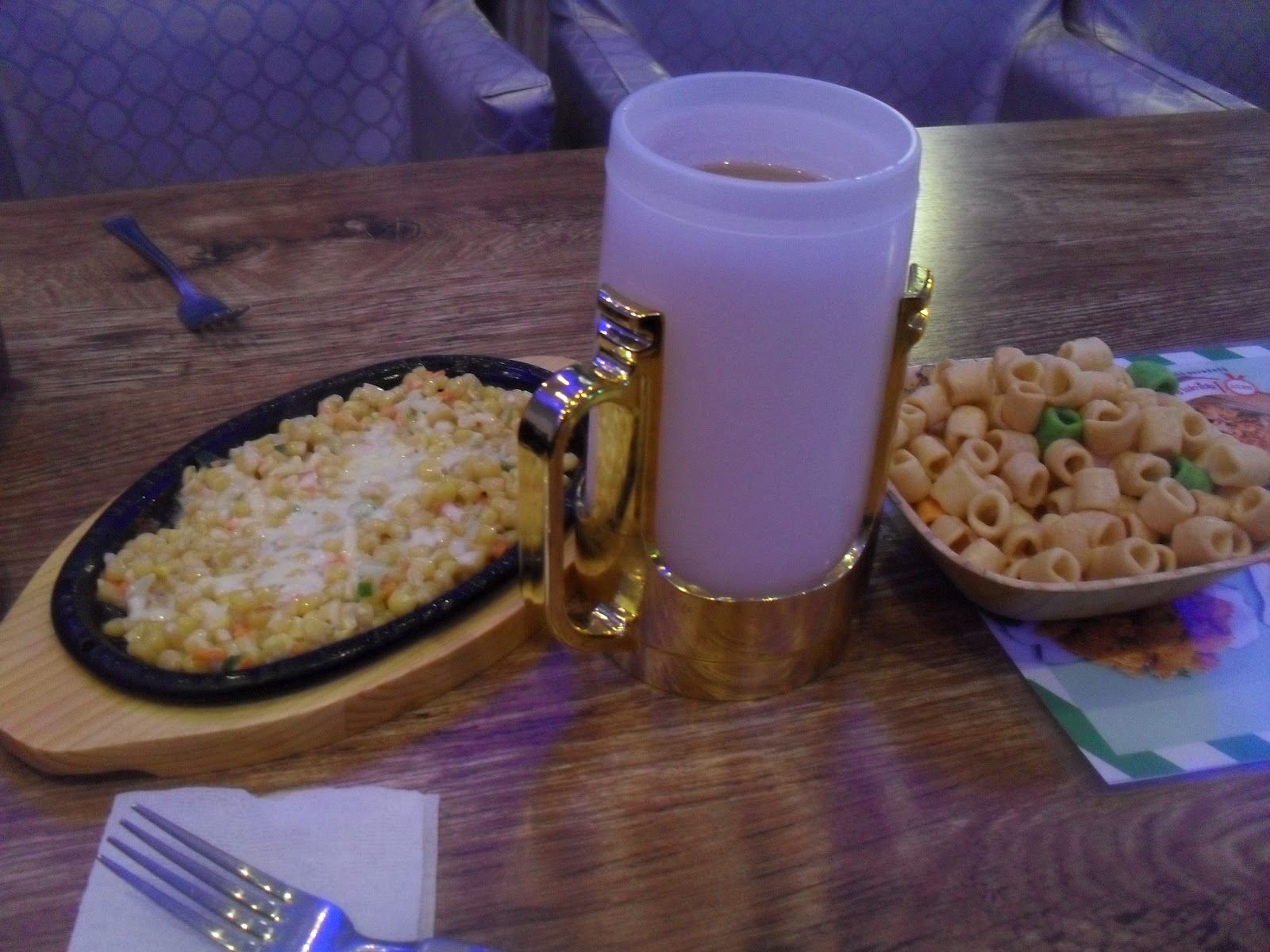
The seafood noodle dish, inspired by Japanese cuisine, is good, but it's greasy. The Mr. and I liked it.
But we also tried a salad which was not good. The salad is fried chicken and fruit on a bed of iceberg lettuce, drowned in sweet dressing. The dressing is completely unnecessary on the fruit. They should put the dressing on the lettuce and serve the fruit unmolested on the side.
So, do not eat at Munchen Ice Pub. Drink there, throw your pint at the wall, and have a merry time.
Munchen Ice Pub drinking: ★★★★
Munchen Ice Pub food: ★★
This series is specifically targeted to the sloppy, drinking masses. You know who you are.
The first place I would like to recommend to you is Munchen Ice Pub. Its name is good for practicing reading Korean. Actually, I would probably not have figured out that 뮌헨 is Munchen if it weren't printed on the windows. But ice has three syllables. That's easy.
뮌헨 아이스 펍
Munchen Ice Pub
| Munchen Ice Pub |
Munchen Ice Pub has one thing that raises it above the other drinking establishments: pints made out of ice that you can then throw at a target. Yes, that's right. Drinking is finally a real sport.
So this is a pint made out of ice.
| Ice pint filled with rice beer |
So you drink your cold beer. Then, you stand behind a line drawn on the floor, and throw your ice mug at a target.
| Like so. |
| The Mr. throwing his ice stein at the target |
If you hit the target, you get a prize. Prizes range from 30,000 ₩ to a free beer. It's fun. It's just a splash at carnival games. Plus, it's hard. I've been there three times and I've yet to see anyone hit it.
If you do choose to eat at Munchen Ice Pub, you should know that the food is edible, but not memorable. Everything is, indeed, food, but it's overpriced and not very delicious. I recommend eating elsewhere.
The seafood noodle dish, inspired by Japanese cuisine, is good, but it's greasy. The Mr. and I liked it.
| Seafood noodle dish at Munchen Ice Pub |
| Salad |
So, do not eat at Munchen Ice Pub. Drink there, throw your pint at the wall, and have a merry time.
Munchen Ice Pub drinking: ★★★★
Munchen Ice Pub food: ★★
Monday, March 12, 2012
New job!
I have begun my new job as a teacher trainer for Seoul public schools, and I love it.
I'm at the Seoul Education Training Institute, which is near Sadang and Bangbae stations in southern Seoul. I have a beautiful, big apartment and a very nice desk in the administration building. We're currently teaching a Travel English course to school administrators planning a business trip to Singapore. Today I'm teaching them English for the airplane. I made them a little boarding pass.
Also, I just finished editing a teenage paranormal romance novel called Soul Thief. I'm excited for its release! You can buy it on Kindle, or pre-order a hardcover.
I hope to continue posting about the Korean language and living in Dongtan soon. Thanks for reading, and thanks for your patience!
-Linguist Ashley
Wednesday, February 22, 2012
Boss BBQ ★★★★
Next to Central Park is a vibrant neighborhood with bars, restaurants, PC bangs (internet cafes), and even an animal hospital. Because the Mr. teaches at a private school until 10pm, and then often grades until 11pm, we have to eat at places that stay open late.
One of our favorite late-night spots is Boss BBQ. They specialize in chicken and beer. You can get 3000 cc of Cass (a Korean lager that has become more popular than Hite) for only 14,000₩. That's equal to about 8 bottles of beer. If that's too much, you can get 2000 cc for 10,000₩. Either way, it's a steal.
But Boss BBQ doesn't want you to drink without eating. It's not allowed. So you can order their specialty, chicken.
Their menu is very foreigner-friendly. It has pictures you can point at. If you read Hangeul (like you really should! It's super easy to learn) you will be sitting pretty.
One of their specialties at Boss BBQ is boneless fried chicken in a sweet sauce. It's a lot like the General Tso's chicken that you can get at Chinese buffets in the US. And it's delish, but definitely not healthy.
Perhaps because specializing in beer and chicken is not a totally healthy lifestyle choice, Boss BBQ serves salad as a side dish with every meal. You can get free refills of your salad.
Boss BBQ also has more Korean-style chicken. This dish is an entire chopped chicken (bones in) simmered with vegetables. It is probably healthier than the dish above because it's not fried and it had vegetables. Also, the parts of the chicken were recognizable, so you know what you're eating. ("Found the neck!") It wasn't as delicious, though.
For a place that specializes in chicken, it's strange that the Mr. and I like their non-chicken dishes better. Boss BBQ serves a mean budaejjigae (army stew), served with loads of mushrooms, sprouts and hot dogs. The Mr. also likes their fruit plate.
In the picture above, you can see tomatoes on the fruit plate. Yes, tomatoes are technically fruit, but Westerners typically treat them as vegetables, serving them in savory dishes. Koreans treat tomatoes as fruit. They are served on top of cake, along with grapes and kiwis. I even got tomatoes with some chocolate fondue once. Linguist Ashley does not recommend tomatoes dipped in chocolate.
We like Boss BBQ because it's open late, the food is good, and the beer is cheap. As if that wasn't good enough, the old man who runs it is super-nice. Last night we asked him for some rice to go with our budaejjigae. He didn't have any, so he ran to the convenience store and came back with a microwaved plastic container of white rice. He gave it to us as service. Koreans sometimes give customers a freebie, called service, to inspire customer loyalty. Then the old man went back to his booth, eating chicken and drinking soju with a shotglass. We love him.
The final reason we like Boss BBQ is that it's not obnoxiously busy. The music isn't too loud, it's not too noisy or too smoky, and the clientele is less drunk than at other places. It's a classy drinking establishment.
Our only real problem with Boss BBQ is that we tend to go to Boss BBQ too often.
Boss BBQ: ★★★★
A star is deducted because not all dishes are as delicious as the fried chicken and budaejjigae, but it definitely beats Kkanbu Chicken.
View Boss BBQ in a larger map
One of our favorite late-night spots is Boss BBQ. They specialize in chicken and beer. You can get 3000 cc of Cass (a Korean lager that has become more popular than Hite) for only 14,000₩. That's equal to about 8 bottles of beer. If that's too much, you can get 2000 cc for 10,000₩. Either way, it's a steal.
But Boss BBQ doesn't want you to drink without eating. It's not allowed. So you can order their specialty, chicken.
Their menu is very foreigner-friendly. It has pictures you can point at. If you read Hangeul (like you really should! It's super easy to learn) you will be sitting pretty.
One of their specialties at Boss BBQ is boneless fried chicken in a sweet sauce. It's a lot like the General Tso's chicken that you can get at Chinese buffets in the US. And it's delish, but definitely not healthy.
| Boss BBQ's boneless fried chicken |
Perhaps because specializing in beer and chicken is not a totally healthy lifestyle choice, Boss BBQ serves salad as a side dish with every meal. You can get free refills of your salad.
Boss BBQ also has more Korean-style chicken. This dish is an entire chopped chicken (bones in) simmered with vegetables. It is probably healthier than the dish above because it's not fried and it had vegetables. Also, the parts of the chicken were recognizable, so you know what you're eating. ("Found the neck!") It wasn't as delicious, though.
| An entire chopped chicken with vegetables |
For a place that specializes in chicken, it's strange that the Mr. and I like their non-chicken dishes better. Boss BBQ serves a mean budaejjigae (army stew), served with loads of mushrooms, sprouts and hot dogs. The Mr. also likes their fruit plate.
Gloss:
부대 찌개
army base stew | 부대찌개 and fruit plate at Boss BBQ |
We like Boss BBQ because it's open late, the food is good, and the beer is cheap. As if that wasn't good enough, the old man who runs it is super-nice. Last night we asked him for some rice to go with our budaejjigae. He didn't have any, so he ran to the convenience store and came back with a microwaved plastic container of white rice. He gave it to us as service. Koreans sometimes give customers a freebie, called service, to inspire customer loyalty. Then the old man went back to his booth, eating chicken and drinking soju with a shotglass. We love him.
The final reason we like Boss BBQ is that it's not obnoxiously busy. The music isn't too loud, it's not too noisy or too smoky, and the clientele is less drunk than at other places. It's a classy drinking establishment.
Our only real problem with Boss BBQ is that we tend to go to Boss BBQ too often.
Boss BBQ: ★★★★
A star is deducted because not all dishes are as delicious as the fried chicken and budaejjigae, but it definitely beats Kkanbu Chicken.
View Boss BBQ in a larger map
Subscribe to:
Posts (Atom)