Showing posts with label Hangeul. Show all posts

Tuesday, February 7, 2012

How to Learn to read Hangeul Part 4/4

If you've gotten this far in my How to Learn Hangeul series, you are probably serious about learning to read Korean. If you've been practicing your flashcards, guess what? You already read 한글. If that was your goal, you can stop reading. You will be able to go to a Korean 레스토랑 and recognize if they serve 김치, 김밥, 라면, or 비빔밥. You'll know if a person's family name is 김, 백, or 이. You will be able to read a ton of loanwords and your time in Korea (or some city's Koreatown) will be immeasurably enhanced. You will already know more than most foreigners. In short, if you are not interested in learning to speak Korean, and only in reading, you can stop.

This post is more for people who want to speak Korean. If you want to continue your Korean studies beyond sounding out English loanwords, keep reading. In this lesson you will learn about initial devoicing (it's much more simple than it sounds) and how to pronounce some tricky final consonants. Your pronunciation of Korean will improve. In time, this knowledge will also help your listening comprehension.

Voicing and Devoicing
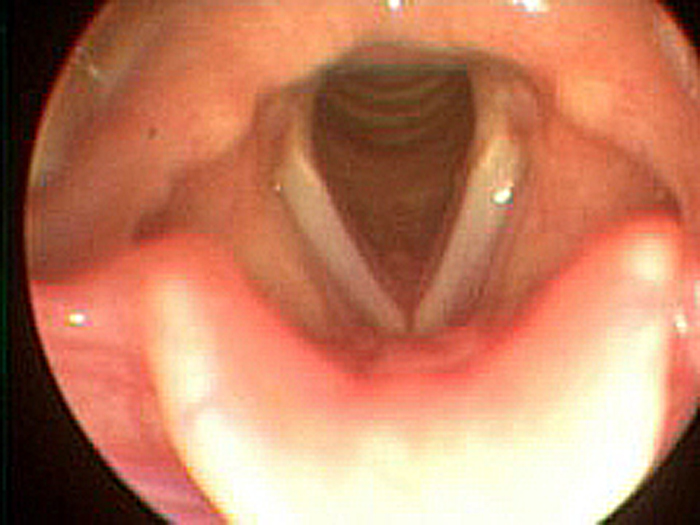
In an earlier post I showed a picture of your relaxed vocal cords. We need to talk about those cords some more.

I hope you are not in public, because I want you to make a z sound. Go ahead. Really. Don't whisper or it won't work. Make a loud z sound.

Now put your hand on your throat. (Trust me, this is all related to reading Korean.) Do it like this:
No manicure. No lipstick. Just phonology.

When you make a z sound, you should feel your throat vibrating. That's your vocal chords! Cool, huh? Now make an s sound. Your fingers don't vibrate. Now make a z sound again. Now they're vibrating. Switch between a z sound and an s sound. When you make a z sound, your vocal cords vibrate. They don't vibrate for an s sound.

The vibration of the vocal cords is the only difference between a z and an s. The z is voiced and s is devoiced (or voiceless). There are a few other pairs of sounds which are only distinguished by whether they are voiced or not.

Voiced   Devoiced
z             s
b             p
d             t
g             k
 j             ch

(In English, the ch sound is not exactly a devoiced j, but we can think of it that way in order to read Korean. I'm simplifying here. Also, Korean doesn't really have a z. That's why the amusement park in Seoul, Everland, has a 주토피아. That's zoo-topia, not Jew-topia. My friends and I thought that was funny.)

Initial devoicing

If you are in Korea, or if you have spoken with Koreans, you may have noticed that at times they seem to say "Pusan" for Busan and "Taegu" for Daegu. You also may have heard "kalbi" for galbi and "pibimbab" for bibimbab. Of course, they are pronouncing these Korean city names and word correctly. This phenomenon is called initial devoicing.

If a voiced consonant is the first word in a sentence, or after a pause, Korean will devoice it. 

So if these Korean letters are first, they are pronounced like their devoiced counterparts:

Voiced     Devoiced


Don't devoice these
Sometimes, though, the Korean language wants the initial sound to be voiced. That's where those weird double consonants come in. These four double consonants are not devoiced. You pronounce them very much like their voiced simple consonant counterparts.

ㄲ ㄸ ㅃ  ㅉ 

(There is another double consonant, ㅆ, which is always devoiced. Just, you know, so this process is not too straightforward and simple.)

Usually, these double consonants are Romanized as kk, tt, pp, and jj. However, you will make a closer approximation of the Korean pronunciation if you pronounce them as g, d, b, and j.

ㄲ  g
ㄸ  d
ㅃ  b
ㅉ  j

(There is a slight difference between the voiced simple consonants and their voiced double consonant counterparts. But don't worry about that right now. Maybe don't worry about that ever. Let's keep moving.)

Final consonants of syllables (받침)


You already know that some syllables in Korean can end in a consonant. For example, the middle syllable of my name has a ㄹ: 쉴. 


If a syllable ends in a consonant, that consonant is called a batchim (받침), which means support or small plate. Most batchims are relatively easy. In the above syllable, you see a ㄹ and you pronounce a ㄹ.

Some batchims are more complicated. All three of these letters in the batchim position sound like  ㄱ: ㄱ, ㄲ, ㅋ.

Therefore, these three words are all pronounced "pag": 박, 밖, 밬

They are not pronounced "bag" unless the syllable is not initial. For example, if I were saying "미스터 I would say "mi-seu-teo-bag" (Mister Park).

Any of these letters in the batchim position are pronounced ㄷ: ㄷ, ㅌ,ㅅ,ㅆ,ㅈ,ㅊ,ㅎ

This is why the Korean loanword for cheese must be two syllables (치즈).  If you just write 칮 it would be pronounced "chid."

Double batchim
 
I know I've already given you quite a lot to think about as you read Hangeul, but I really must mention the double batchim and their special rules. Actually, had history gone a little differently, there might not be any of these. King Sejong, the Korean king who commissioned brilliant linguists to invent Hangeul, liked Korean spelling to reflect the root words rather than the actual pronunciation. He liked etymology. Had he preferred regular orthography--spelling that makes perfect sense--I could stop writing this post now and get back to watching my totally not-illegal download of Hugo. But, sigh, he liked the spelling to reflect the words it was related to. So here we go.

There are number of double batchims: ㄳ ㄵ  ㄶ ㄺ  ㄻ  ㄼ ㄽ  ㄾ  ㄿ  ㅀ  ㅄ

Most of these are so rare, I'm not going to waste time telling you how to pronounce them. Trust me: the issue won't come up too much. Try not to flip out if you happen to see one.

But there are a couple that are important. ㄺ and  ㄻ are just pronounced ㄹ.

When a double batchim is followed by a syllable that begins with a vowel sound, the double batchim carries over to the second syllable. So the word  있어요 (meaning "exists" or "have"--I'll get to this word and its meaning when I move on to speaking Korean) is pronounced ee-seo-yo.

There are a lot of other rules for pronouncing these double batchim. My advice is: don't waste your time. Remember that they have different rules, and just move on.


And one last thing ...
 ...just to really confuse you. When people have a final consonant in English, it is really enunciated. The final t in cat has to be really heard. It's different in Korean. (If you've taught Koreans ESL and struggled to get them to pronounce final consonants, you know what I'm blogging about.)

Korean final consonants lack the final puff of air that English consonants have. It's like they form the consonant with their mouth, then don't actually pronounce it. Thus, 집 can sound like "chee" and 밥 might sound like "pa." Just be aware of it.
 
Practice

Try reading these words aloud. I have chosen words which will be helpful for you to know during your time in 한국 (Korea). Try to remember the initial devoicing and all the batchim rules. The answers (Romanized) are below. And you can always copy and paste into Google Translate to hear a native speaker pronounce it.


빵 (bread)
빗 (comb)
진짜? (informal way of asking Really?)
꽃 (flower)
옷 (clothes)
닭 (chicken)
집 (house)
감사합니다 (thank you)
없습니다 (there isn't any/don't have)
김밥
찜질방 (public bathhouse)
부대찌개 (army stew)
시내 (downtown)
빨리빨리 (informal: hurry up)


Answers
(Please don't post a comment that I'm "wrong." I know that most websites Romanize these words differently. I'm Romanizing these in order to teach you initial devoicing. Most websites don't do that. So thank me instead of trying to correct me.)

bang
pit
chinja?
god
od
tag
chib
kam-sa-ham-ni-da
eob-sum-ni-da
kimbab
jim-jil-bang
pu-dae-ji-gae
shi-nae
bal-li-bal-li

Saturday, January 28, 2012

How to Learn Hangeul Part 3/4

Right. You have now learned all the vowels and consonants. You've been practicing reading loanwords. If you are in Korea, I'm sure you've been sounding things out. (In Western-style cafes and restaurants you can read more loanwords, I'm sure.) In this lesson we're going to learn the remaining vowel combinations, how to say sh, and read some more loanwords. 가자! ('Sko!)


Vowel Combinations
You've already learned all the vowels, but some vowel combinations turn out sounding different than you'd expect. Korean treats the sounds w and y as vowels. 


Y


(Because we like you. Mickey Mouse Club? Anyone?) If you see a double line attached to a regular vowel, it means there's a y sound before the vowel. Gentlemen, start your flashcards.


ㅕ yeo
ㅑ ya
ㅠ yu
ㅛ yo
ㅒ yae
ㅖ ye

(If you recall,  ㅐ and ㅔ are actually pronounced the same. Similarly, ㅒ and ㅖ are both pronounced "yay" by almost all Koreans.)

If you continue to study Korean, you'll see ㅛ at the end of a lot of sentences. "-yo" is the polite, or honorific, verb ending.


W


Adding a ㅗ or a ㅜ to any other vowel puts a w sound in front of that vowel. Whether or not a vowel takes ㅗ or ㅜ depends on whether it is a dark or a bright vowel.

ㅘ wa
ㅝ weo
ㅚ we
ㅟ wi
ㅙ wae 
ㅞ we 

(I'm sure you're wise by now to the fact that both ㅙ and ㅞ are pronounced like the English word "way." Good news! ㅚ is pronounced like "way" too.)


And the one that has no English equivalent
Maybe this one is just in here because learning Hangeul was too easy. Remember the ㅡ vowel that you make by making a grimace while you make a u sound with the back of your throat? To make this diphthong (vowel combination), say the  ㅡ vowel and then quickly say ㅣ. It helps if you don't move your lips. Keep them stretched wide across your face (like you've been off guard by a would-be photographer although you don't want your picture taken) as you make both sounds. Don't try to be perfect. Just keep going.

ㅢ eui

If you want to hear this vowel, copy this Hangeul syllable: 의. Then, go to Google Translate and paste the syllable into the box on the left. Finally, click on the volume sign to hear a native speaker say the vowel.
SH

This is pretty simple. When Koreans see a ㅅ + ㅣ, it is pronounced "shee." The Korean language does not allow the pronunciation "see." (If you've ever taught low-level Koreans English, you may have noticed their love of "sheefood".)

시 shee

This rule also applies in some (rare) vowel combinations.

쇼 shyo
쇠 shwe


More Reading Practice
After you more or less have a handle on the vowel combinations, try reading the following loanwords:

컴퓨터
샌드위치 
위스키
콜라  
주스
카메라
노트북
피아노
아이스크림
테니스
오아시스
오렌지
레몬


Now try reading these proper nouns:


뉴질랜드
애슐리
뉴욕비너스
파키스탄
스웨덴
스위스
서울
보츠와나
베네수엘라
과테말라
필리핀
덴마크


Answers:

computer
sandwich
whiskey
cola
juice
camera
notebook (meaning laptop)
piano
ice cream
tennis
oasis
orange
lemon


New Zealand 
Ashley 
New York
Venus
Pakistan
Sweden
Swiss (meaning Switzerland)
Seoul
Botswana
Venezuela
Guatemala
Philippines
Denmark

Thursday, January 26, 2012

How to Learn Hangeul Part 2/4

Weren't consonants easy? I bet you mastered all of them after only going through your flashcards twice. Sometimes I used to get ㄴ and ㄱ mixed up, but everything got straightened out pretty fast. Ah, Korean consonants. Those were the days.

Vowels

I'm not gonna lie. Vowels are little tougher, and I blame two things: English's dysfunctional orthographic system and the less-than-intuitive philosophical designs of the Hangeul vowels. I'm spreading the blame around.

Even though English has about 15 vowels, it only has 5 letters to represent these vowels. It's tough to even describe which vowels a Korean letter represents in English. (One of these vowels simply doesn't exist in English.)

Those brilliant linguists who devised a simple way to write consonants--so simple it was called "The Writing You Can Learn in a Morning"--got pretty esoteric when it came to their vowels. I'll try to explain the vowel and the English vowels they correspond to, but this is where real world experience trumps blog-learnin'. Do your best to keep moving and don't get bogged down in details.

Basic vowels

This is a picture of a person: ㅣ
You pronounce that vowel as the ee in beet or the i in bit.

This is a picture of the earth's horizon: ㅡ
This is the vowel that doesn't exist in English. You basically say the u in boot, but pull your lips wide instead of rounding them. Learn more by clicking here. It is Romanized (written in English characters) as eu. If you just say it like the uh in but, you'll be fine.

The vowels in Hangeul are based on these two basic symbols.

ㅣee (as in beet) or i (as in bit)
ㅡ eu 

The person vowels
Based on the vowel that represents a person, ㅣ, we can have a "dark" person and a "bright" person. (I know, it seems weird to me too.)

The bright person has their left hand sticking out (on our right): ㅏ  
This is pronounced like the a in father.

The dark person has their other hand sticking out:ㅓ
This is pronounced like the u in plus. Learn more here. It is Romanized as eo.
ㅏ a
ㅓ eo

The earth vowels
The earth vowel also has a dark and a bright variation.

Bright earth has a line above it: ㅗ 
It is pronounced like the o in boat.

Dark earth has a line below it: ㅜ 
It is pronounced like the oo in boot, or the Spanish u if you know Spanish vowels. It's Romanized as u.

ㅗ o
ㅜ u

Two person vowels
When a neutral person and a bright person get together, it looks like this: ㅐ
See how that has a ㅣand a ㅏ?
This vowel is pronounced like the e in pet or the a in Ashley. It is Romanized as ae.

When a neutral person and a dark person get together, it looks like this: ㅔ
 This vowel is pronounced like the ay in way. It's Romanized as e, and it's also similar to the Spanish e.

ㅐae
ㅔe
(Actually both of these vowels are pronounced as the a in cat or the e in pet. You can pronounce both of these the same and you'll sound like a native speaker of Korean. They were distinctive for centuries, but now they sound the same. It's like in English, how the w in witch used to be distinctive from the wh in which, and now they are the same. Except for Stewie Griffin, of course.)

Your first Korean words

Now you have the eight basic Korean vowels. There are also compound vowels, but that's enough for now. We're going to put the consonants and the vowels we know to the test. 

You don't have to memorize all the vowels completely before beginning this part. In fact, learning these words will help you to figure out those confusing Hangeul vowels.

 I want you to sound out the following loanwords that Korean has borrowed from English and other languages. Remember that ㅇ is silent if it is the first letter in a syllable, and ng if it is the last letter in a syllable:

라디오
토마토
커피
호텔
택시 
햄버거
텔레비전 
후렌치후라이
라지 치즈 피자
스포츠 
마사지 

Now sound out the following names of countries:

멕시코
폴란드
캐나다
나이지리아
네덜란드
아일랜드
인도네시아  
러시아

The answers are below, but don't look until you've sounded all these out. You can do this.

I'm sure you noticed a lot of interesting things. For example, Korean doesn't have an f, so they replace fs with p (in  커피) or h (in 후렌치후라이). Neither is there a Korean v, so you'll see it replaced with ㅂ. Also, Koreans use the letter ㅈ for both j and z. Finally, the dental consonants can't end a syllable, so Korean adds one of the basic vowels to the end of the word. (I used to hear them talk about President Bushy.)

All these differences will become second nature to you after a few weeks of practicing Hangeul.

In addition, you have by now noticed that each syllable exists in its own square. There are a lot of rules as to how these syllables are shaped, but they are easier to just pick up than to memorize the rules one by one. Practice reading, and you won't need to memorize a bunch of rules.

Now make flashcards of the loanwords and countries. Shuffle them into your vowel cards and practice. Also practice any consonants you have been having trouble with.

YOU'RE READING KOREAN!!!


Answers:

radio
tomato
coffee
hotel
taxi 
hamburger
television
French fries
large cheese pizza
sports
massage

Mexico
Poland
Canada
Nigeria
Netherlands
Ireland
Indonesia
Russia

How to learn Hangeul Part 1/4

Learning the Korean alphabet is much easier than you think. It's so easy I'm surprised more people don't do it. It will take you about two hours to completely master the consonants and to gain general knowledge of the vowels. Mastery of the vowel system takes more practice, but you can get around very well without mastery. To learn the Linguist Ashley way, you'll need to buy some index cards to turn into flashcards. 

(Note to linguists: You are not my primary audience. I hope that people untrained in linguistics can use this guide to learn to read Hangeul. I know phonology, and I know these sounds might be explained differently in a phonology class, but these were the classifications apparently used by King Sejong's linguists.)

CONSONANTS

The linguists who invented the Korean alphabet were no dummies. They wanted it to be easy for normal people (at the time, farmers and peasants) to learn. They actually made the consonants stylized pictures of the human mouth making these sounds. As the Guinness commercial said, Brilliant.

I am going to explain the Korean consonants in a way that will help you recognize the way they are written in Hangeul.

The Bilabials (ones you make using mostly your lips)

This is a picture of a closed human mouth viewed from the front: ㅁ
Make an m sound. Your mouth should be closed and the lips pressed together. The square is a stylized picture of your mouth making the m sound.

Now make a b sound. b starts as m, with your lips closed and pressed together. Then you make a puff of air.

This is a picture of a closed human mouth, but with a puff of air: ㅂ
The two lines at the top are the puff of air. Make sense?

Now make a p sound. Does it seem like it has a more powerful puff of air? The Korean linguists who created this system thought so. 

This is a picture of a closed human mouth making a bigger puff of air: ㅍ
It has lines coming from the top and the bottom of the square.
Now take 3 index cards and write these three Hangeul letters on one side and the corresponding English letters on the other side.

ㅁ m
ㅂ b
ㅍ p

The Dental consonants (the ones you make by pushing air between your teeth)

These symbols are also stylized views of the human mouth viewed from the front. This is a picture of the human mouth making an s sound: ㅅ

I like to imagine this as the person's lips slightly raised to show the front teeth as she pushes the air between the teeth to make the s sound. Easy, right? 

Now, make an s sound and allow it to morph into a j. The Korean linguists who invented Hangeul fancied a j as like an s, but with more air. Thus their j is an s with an extra burst of air at the top: ㅈ

 I'm sure you can guess how they make a ch. Yep: even more air coming out than a j. They place the extra burst of air at the top: ㅊ

 Now you are ready to make 3 more flashcards:
ㅅ s
ㅈ j
ㅊ ch

Back of the tongue consonants

These are the consonants you make by bringing the broad, flat back part of your tongue up to the roof of your mouth. (Linguists call these velar consonants. Specifically, they are plosives. Maybe I'll get into it in depth on this blog one day.) Korean linguists called these molar sounds because you made them in the same area as your molars. For these symbols, imagine you are a viewing a human mouth from the side.

Make a g sound. Notice how your tongue comes up to the roof of your mouth at the back? Hangeul makes a stylized drawing of this back-of-the-tongue action: ㄱ

So from left to right, that drawing shows the very most back part of the tongue at the top, then the tip of the tongue coming down. Hey, it's stylized.

Now make a k sound. I bet you know what's coming next. That's right: an extra puff of air: ㅋ

Now it's time to make 2 more flashcards:
ㄱ g
ㅋ k

Lingual consonants (made using mostly your tongue)

The alveolar ridge is this hard part of the roof of your mouth. You'll find it if you put your tongue on your front teeth and pull it backwards. It's a hard bump thing on the roof of your mouth at the front of your mouth. The first three lingual consonants use this alveolar ridge.

For these letters, imagine again that you are viewing the human mouth from the side. Make an n sound. Your tongue should go right to that alveolar ridge. The Korean letter that represents the n sound is a picture of your tongue touching the alveolar ridge: ㄴ

Now make a d sound. Your tongue goes to the same place, but instead of humming like you do with an n, you release a puff of air. The Korean letter for d is like an n but with a line representing a puff of air: ㄷ

Now make a t sound. You guessed it--extra puff of air: ㅌ

You may not think that r and l are very similar to n, d, and t. The Korean language has a different relationship to r and l than English. We distinguish between the two. Korean, not so much. For our purposes--namely, so you can read Hangeul--just think of them as the same sound. You make these sounds with your tongue, so Hangeul groups them together.

Make an r sound. Make an l sound. Do you feel how the tip of your tongue curves down, then up, to make these sounds? The Hangeul symbol for r/l is a little squiggle, which is a stylized picture of your tongue as it makes the sound: ㄹ

Now make your flashcards:
ㄴ n
ㄷd
ㅌ t
ㄹ r/l

Throat consonants

These letters represent the human throat as a circle, which it basically is. Here's a picture of relaxed vocal cords.


Here's the stylized picture of your throat in Hangeul: ㅇ
This letter can either be silence, when it is the first letter in a syllable, or it can mean ng if it is at the end of a syllable. We'll memorize both uses and sort them out later.

Make an h sound. Predictably, Hangeul pictures this sound as silence with two puffs of air: ㅎ

(You may be asking, What happened to the single puff of air? It used to be a letter representing a glottal stop. It is no longer used, but it looked like this: ㆆ)

Stop. Flashcard time. 
ㅇ silence/ng
ㅎ h

Double consonants

That's all the consonants you really need to memorize. The rest are double consonants. They are just made by doubling one of the basic symbols. They're so easy you might not want to waste your index cards even making these flashcards. These are called "tense consonants" and you are supposed to make your mouth more tense when you make these sounds. I don't but Koreans always understand me. I wouldn't worry about pronouncing these differently than the single consonants until you've already mastered reading Korean. Even if you live in Korea many years, you probably won't ever need to distinguish between regular and tense consonants; Koreans can understand you.

gg
 dd
 bb
 ss
 jj

*  *  *

That's it! That's all the consonants. Take a few minutes and go through the 14 (or 19, if you made flashcards for the double consonants) flashcards you made. I like to put them in my purse and study them when I'm waiting in line or for an elevator. You should master them in about an hour. 

When you've memorized the Hangeul consonants, we'll move on to vowels.

Monday, January 23, 2012

Kindergarten homework

A lot of people ask me how I am learning Korean. Well, the Pimsleur CDs help me with my pronunciation, and I learned the alphabet using flashcards, but one of my secrets of language learning is to do homework for kindergartners.

When I was Daegu four years ago a Korean friend gave me some old workbooks that a little cousin never finished. These are published by Samsung. The one I most recently finished looks like this:

It is a book to help 5-year-olds learn to read Hangeul. Inside, it has pictures of things that I assume all Korean children know, like hippos, pumpkins, and harmonicas:


You are supposed to write the vocabulary words over and over. The repetition helps you to remember the vocabulary items. (I remember a high school Spanish teacher employing this method when students didn't do their homework.) This helps me not only learn new vocabulary items, but also their educational system. What Westerners call "rote memorization" has been a feature of education probably since humanity first began: poets memorized stories like the Iliad and Beowulf, and griots memorized genealogical lines. Repetition is still a feature of the Korean educational system, although that is slowly changing.

I've worked through three of these books now, and in addition to learning the Korean words for hippo and pumpkin, I've gained an appreciation for the amount of effort and time that Korean 5-year-olds are expected to do homework. The book pictured above is 64 pages long. It took me over 3 hours to complete. My hand cramped and my mind wandered. I remember in kindergarten and 1st grade doing about one page of homework a night, and none of it was repetitious. Koreans work hard, and they start at an early age.

Working through a kindergartner's homework gave me an appreciation for the Korean work ethic, and it also taught me the word for hippo. Now I'm off to buy a moisture absorber hippo. Good thing I learned the vocab.