Thursday, February 2, 2012

The Art of Dongtan

Dongtan is a beautiful city to live in. As a planned city, the layout of the streets is a work of art in itself. As I wander through these streets, which are neither perfect grids nor as chaotic as medieval cities, I keep coming across artistic treasures. I've taken pictures of most of them so you can see how fun it is to explore Dongtan.

This is one of my favorites. It looks like a child's play-dough creation blown up to be larger-than-life. You can even see the thumbprints. It's like an homage to children's art.

Dongtan's play-dough man
Not far from the Play-Dough Man is a giant sculpture of an onion. Why? I don't know. But it's pretty cool.
Linguist Ashley and the big onion.
 
This one is, apparently, of a colorful ball of yarn which has been used to create a vase. Or maybe it's something else. I'm not sure what it is, but it's colorful and it cheers me.

Yarn and vase

Metapolis has a number of cool sculptures. Two sculptures are of a young couple and an old couple.

Sculpture of young couple

Sculpture of old couple
The coolest thing about the two couples is that they are all four of them facing this fountain. It's like the artist is saying that young or old, anyone can enjoy this public space. Or maybe it's like you can grow old together in Dongtan. It is nice to walk by everyday.

Near the two couples is a stream. Apparently there used to be a natural stream or ditch there; as Dongtan was built, this natural feature was incorporated into the city's design. There are sculptures of little boys catching fish in this stream. Since it is winter, I don't have a very good picture. The boys just look cold in their swimming gear. I can't wait to see this sculpture in the spring.

Fishing boys


Near these sculptures at Metapolis are these two creepy faces. I don't really like this one. For one thing they have no expression, and for another they are missing pieces of their faces, like jigsaw puzzle pieces that got kicked under the couch. They remind me of sad robots.

Kinda creepy!
If you walk away from the creepy faces and follow the stream, you have to walk up some stairs. Next to the stairs are sculptures of fish swimming upstream.

The struggle to flop upstream

Frozen fish

If you keep walking and follow the stream, you'll come to Central Park's pagoda.It is painted brightly in a very Korean way.
Central Park's pagoda

This is an even more beautiful pagoda in an apartment complex. (The complex is right on the street; I'm not creeping through private property!) The roof was not cemented together and it has unpainted wood, giving it a more natural feel than Central Park's pagoda.

An even better pagoda
Different apartment complexes invest in beautiful sculptures. This sculpture has three figures dancing in a circle. The figures are stylized, massive, playful, and above all balanced. It isn't easy to make weighty bronze figures balance on one hand or foot. 

Three Dancers
Of course, many of the sculptures I encounter in Dongtan are abstract, metallic, corporate sculptures that I pretty much just hate.

Nice bent paperclip.
Little metallic spheres.

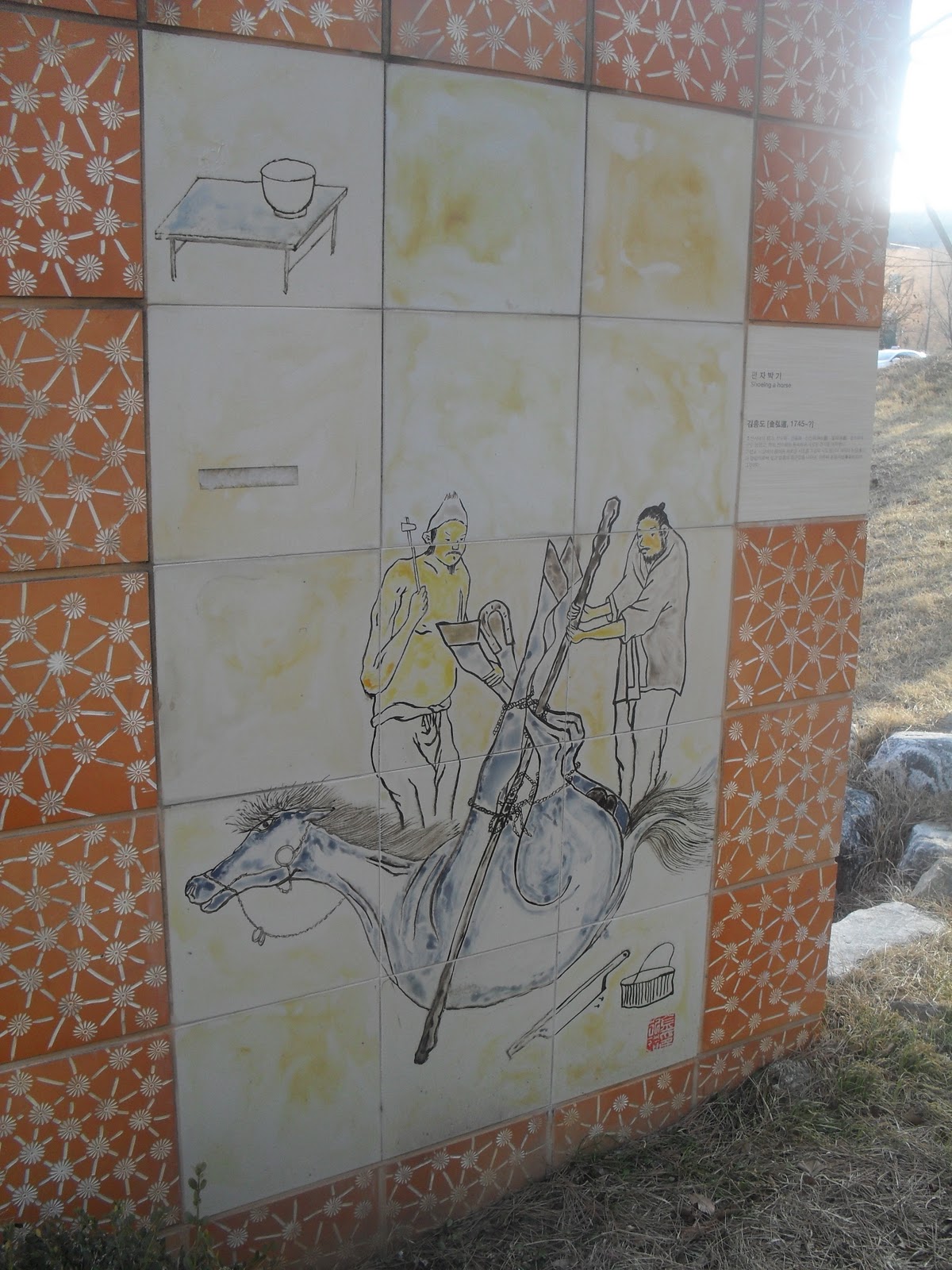
But there are so many hidden art treasures that I just overlook the corporate sculptures when I can. I discovered, near the metallic spheres, public monuments to a classic Korean artist. There is a long wooded lane through which I walk to reach the post office. It has a series of stelae with reproductions of Joseon-era artworks by the great Kim Hong-Do. I love to stop and look at them and imagine what life would have been like for the Korean working class.

Sailing Home

Merchants peddling their wares

A Roadside Tavern

Boy Crossing a Stream on an Ox


Begging for alms

Korean wrestling


Fishing


Shoeing a horse


As a new and planned city, Dongtan is full of architectural surprises. It's marvelous to walk by beautiful works of art every day.

Café Mano ★★★★★

I have discovered the most perfect coffee shop in Dongtan. Behold, Café Mano!
Café Mano

The outside plainness is deceiving. On the inside, it is precious. It is worthy of Pinterest. Look at the cuteness.
This is a beautiful way to store your mugs

My reading corner
A painter comes in and paints these tiny paintings right in the café

The fine ladies behind the counter speak some English

But it's not all unfinished wood and quilts! No, they have coffee so good, they really shouldn't call it Americano. Outside of the US, I have become accustomed to being served watered-down espresso and calling it by my country's name. It used to bug me. I am now merely resigned (and I now have to admit that most percolators, if anything, produce even worse brew than watered-down espresso).

But Cafe Mano makes their Americano rich and creamy. They serve it with two sugar lumps and no cream. Somehow, it's perfect.
Photo by Eric Wong
They also have food that is unbelievably good. I ordered homemade soy salad on a bagel. The only thing was, I didn't know what I had ordered. I didn't know what 수제소이 was. As I ate it, I thought it was chicken salad! Their soy tasted like chicken. They served it with apples cut up in it, and the bagel was hot and toasty. Mmmm.

Soy salad set
The prices are reasonable. For the meal pictured above I paid approximately 8000 ₩ ($7.11). The quality of the food and coffee, as well as the twee atmosphere (unique in Korea), make this set a steal.

Honey Bread
If you're craving something sweet, try the honey bread. Delish!

I give Café Mano five stars out of five. If you are in Dongtan, get yourself to Café Mano. It is located literally next door to my apartment. Here is a map. This is a wonderful place to spend an afternoon.


View Cafe Mano in a larger map

Monday, January 30, 2012

A Separation proves less is more

The Iranian film nominated for Best Foreign Language Film and Best Original Screenplay, A Separation, is rewarding and memorably old-fashioned. It had no CGI, no fancy direction, no shaky-handheld cameras, no narration. It's a drama. It could have been made in 1980 or 2011; the themes are timeless. It has a powerful story to tell about people going through very hard times. The acting was so good I forgot I was watching a movie. The plot was so complex I rewound back to a pivotal moment to watch it again. The direction never got in the way of the story (unlike The Tree of Life, to name an obvious offender).
This young lady broke my heart.

It is an unusual film to receive such positive word-of-mouth because it is so different from the films that usually get accolades. Drive had slick, stylized direction and hip stars. The Descendants had Oscar pedigree and quirky characters grieving in their own ways. The Tree of Life has insufferable pretentiousness. The Artist and Hugo have "movie magic." In fact, I think this film is better than The Descendants, Drive and The Tree of Life. The Artist, however, was pretty special, and I haven't seen Hugo yet.

I think the fact that A Separation lacks so many things that Hollywood spoonfeeds us every year could work to its advantage. This humble drama reminds me of The Hurt Locker. Everyone put their money on Avatar. It made movie history! It's so big and shiny! Then the little movie that could, the one that showcased acting and storytelling first and direction and effects and editing second, stole the Academy's hearts. They remembered what people really love in a film: to hear a story and to see real people's faces. I was underwhelmed by The Hurt Locker, but a Best Picture win might have inflated its stock.

Next month, this little gem could be 2012's The Hurt Locker to The Artist's Avatar (for Best Original Screenplay). If so, you heard it here first.

Saturday, January 28, 2012

How to Learn Hangeul Part 3/4

Right. You have now learned all the vowels and consonants. You've been practicing reading loanwords. If you are in Korea, I'm sure you've been sounding things out. (In Western-style cafes and restaurants you can read more loanwords, I'm sure.) In this lesson we're going to learn the remaining vowel combinations, how to say sh, and read some more loanwords. 가자! ('Sko!)


Vowel Combinations
You've already learned all the vowels, but some vowel combinations turn out sounding different than you'd expect. Korean treats the sounds w and y as vowels. 


Y


(Because we like you. Mickey Mouse Club? Anyone?) If you see a double line attached to a regular vowel, it means there's a y sound before the vowel. Gentlemen, start your flashcards.


ㅕ yeo
ㅑ ya
ㅠ yu
ㅛ yo
ㅒ yae
ㅖ ye

(If you recall,  ㅐ and ㅔ are actually pronounced the same. Similarly, ㅒ and ㅖ are both pronounced "yay" by almost all Koreans.)

If you continue to study Korean, you'll see ㅛ at the end of a lot of sentences. "-yo" is the polite, or honorific, verb ending.


W


Adding a ㅗ or a ㅜ to any other vowel puts a w sound in front of that vowel. Whether or not a vowel takes ㅗ or ㅜ depends on whether it is a dark or a bright vowel.

ㅘ wa
ㅝ weo
ㅚ we
ㅟ wi
ㅙ wae 
ㅞ we 

(I'm sure you're wise by now to the fact that both ㅙ and ㅞ are pronounced like the English word "way." Good news! ㅚ is pronounced like "way" too.)


And the one that has no English equivalent
Maybe this one is just in here because learning Hangeul was too easy. Remember the ㅡ vowel that you make by making a grimace while you make a u sound with the back of your throat? To make this diphthong (vowel combination), say the  ㅡ vowel and then quickly say ㅣ. It helps if you don't move your lips. Keep them stretched wide across your face (like you've been off guard by a would-be photographer although you don't want your picture taken) as you make both sounds. Don't try to be perfect. Just keep going.

ㅢ eui

If you want to hear this vowel, copy this Hangeul syllable: 의. Then, go to Google Translate and paste the syllable into the box on the left. Finally, click on the volume sign to hear a native speaker say the vowel.
SH

This is pretty simple. When Koreans see a ㅅ + ㅣ, it is pronounced "shee." The Korean language does not allow the pronunciation "see." (If you've ever taught low-level Koreans English, you may have noticed their love of "sheefood".)

시 shee

This rule also applies in some (rare) vowel combinations.

쇼 shyo
쇠 shwe


More Reading Practice
After you more or less have a handle on the vowel combinations, try reading the following loanwords:

컴퓨터
샌드위치 
위스키
콜라  
주스
카메라
노트북
피아노
아이스크림
테니스
오아시스
오렌지
레몬


Now try reading these proper nouns:


뉴질랜드
애슐리
뉴욕비너스
파키스탄
스웨덴
스위스
서울
보츠와나
베네수엘라
과테말라
필리핀
덴마크


Answers:

computer
sandwich
whiskey
cola
juice
camera
notebook (meaning laptop)
piano
ice cream
tennis
oasis
orange
lemon


New Zealand 
Ashley 
New York
Venus
Pakistan
Sweden
Swiss (meaning Switzerland)
Seoul
Botswana
Venezuela
Guatemala
Philippines
Denmark

I hate The Tree of Life

It took me 3 days to get through The Tree of Life, pausing and taking long breaks. Sometimes I would resign myself to watch half an hour, then find I hadn't the stomach for it. OMG it's so terrible. It's not that I can't sit through mood pieces. I remember liking The Thin Red Line and Baraka when I saw them in high school. I have since seen many difficult films that rewarded patience and which I appreciated. But The Tree of Life is like a parody of a great art film.

One major problem is that Malick is unconcerned with whether the audience knows what's going on. I was paying attention and even checking my progress in the movie with wikipedia's entry on it, when I realized, Maybe that boy that drowned was the other brother! At first, I thought he was just some kid in the neighborhood; most bloggers thought so too. Then I noticed that the third brother just disappeared. The story didn't just focus on the main character and the blond brother; the third brother wasn't even in the car with the family when they moved. Why wasn't he mourned as much as the other brother? He just dropped out and no one ever mentioned him again. When the blond brother dies at 19, it wrecks the father and mother. The blond brother apparently meant a great deal to the main character. What about the drowned brother? No love for the brother who can't swim.

Another narrative gap which troubles me is: what am I supposed to make of the grown-up main character? Why is Sean Penn in this movie at all? The main character boy grows up, becomes an architect, and contributes nothing to the story whatsoever. He doesn't even wear billowing clothes.

Oh, the treetops with the sun shining through them! Ah, the white billowing curtains being moved by the wind! A man touching another man's shoulder--how tender. Can't you feel the magic? In case you can't there's narration and loud Anglican-style choirs to tell you how spiritual it all is.

Malick insults my intelligence with the voiceovers. I would have understood the film was about God without the simplistic prayers. It's like Malick has so little trust in his audience's intellectual ability to divine themes he has to explicitly tell us the film is about nature vs. grace. I feel like the narration and the bits about the Big Bang and the beginning of life are unnecessary. I would have appreciated the weight of the story without these things. Really. Life is important. I get that. 

Let's explore a more troubling byproduct of Malick's dualistic ideas about the world. The portrayal of the mother as a sinless saint makes me mad. Can we please get away from the goddess-of-the-hearth architype? It's sexist. It teaches young women that they should be perfect angels--a harmful, impossible goal to attain. And Chastain's portrayal of the mother--or possibly Malick's direction of her--annoyed me. She's too soft and "graceful" to say boo to her husband when he hurts their son, or to discipline her children when they terrorize her while the dad is away. Her character is weak. Her self-consciously graceful arm movements, filmed like so many beautiful affectations, exist only in film. No one waves their arms like falling leaves as they lay in the grass. Her scenes are more like magazine photo shoots that have been filmed than real scenes. Real scenes would have, you know, acting.

She charms the butterflies! Submissive feminine perfection!

When the credits rolled I heaved a sigh of relief. Only 2 hours and 13 minutes, but it felt like an eternity. I wish I had known how rough this movie was before I began. I can meditate for a few hours at a time. If I had said to myself, "Ashley, you are now going to watch these images and meditate" I could have handled it. As it was, I thought I was watching a movie. I expected to be challenged--Palme d'Or should mean something!--as well as entertained. I was sorely disappointed.

To all the people who think a great art film needs patience and multiple viewings, I say TRUE but that doesn't excuse the director from incoherence or pandering. One or the other is enough to damn a film. This is a difficult film, but not because Malick thinks the audience is bright enough to analyze it like Faulkner's The Sound and the Fury. It's difficult because he thinks you are too stupid to get the dualism or religious themes unless he hits you over the head with it. It's difficult because it sucks. Malick sucks too. This movie is so bad it's bad.


Friday, January 27, 2012

Suwon

Last weekend the gang decided to head to Suwon. And so we did. 

Suwon is famous for two things: its UNESCO fortress wall and galbi (beef ribs). We tried to eat galbi at a place in the Lonely Planet, but they jacked up their prices after lunchtime and we figured we could do better than 25,000 won per person. We walked through the ancient part of Suwon, where people live in hanok, and found this amazing place. We didn't take a picture of it (d'oh!), and I can't find it on the map, but if you get a taxi to take you to Yeonpo Galbi, begin walking towards Janganmun. When you see a sign that says "Janganmun 400 metres", turn to your right. That's the place. They served us whole crabs as a side dish! The Mr. went to town on those. My favorite was the owner's homemade 쌈장 (the orange spicy paste). I'd never had it homemade before, and it was amazing!

So after you eat yourself silly, there's nothing like a long, uphill hike in the freezing cold. We walked along the fortress wall to an outlook post that's on top of the highest hill.

The view from the Southwest Pavilion

We need lots of couple photos while we're still young and sexy
So we clowned around there for awhile and headed back down. At the base of the hill there's a spring where locals can come get fresh spring water.

Natron getting spring water
Across from the spring are the restrooms. Inside the restrooms we heard a guy singing plaintively a song with the memorable words: Pa chil a gong gong, pa chil a gong gong. YK told us the song was about a guy who loved a woman so much he tied her down so she wouldn't leave. That's about as creepy as hanging out in a bathroom singing. 

YK had heard of a big jjimjilbang in Suwon, so we took a taxi there. (Taxis are ridiculously cheap if you have 4 people in the car.) Both YK and I had been to many a mogyogtang (naked, sex-segregated sauna) before, but the Mr. and Natron never had. They were, however, "ready to get intimate" as they put it.

This was a big, nice mogyogtang. They had different sauna rooms of varying temperatures, cold baths and hot baths, an outdoor bath, water jets for back massages ... just about everything. We soaked for awhile and talked, then put on our jjimjilbang outfit and met the boys in the jjimjilbang.

Natron, the Mr., Linguist Ashley and YK at a jjimjilbang
We relaxed here, getting in different saunas, hot and then cold, and eating corn and mandu when the galbi wore off. I love jjimjilbangs. I can't believe how cheap they are. You can pay about 8000 won and even spend the night. It's a great way to travel cheap. It's much more entertaining than any hotel, and easily one-fourth the price.

We had a great night in Suwon, doing three very Korean things: grilling our own food in a restaurant, hiking up a hill, and chilling in a jjimjilbang. For four 외국인 (foreigners), it was a very Korean excursion. We even capped off the night with a visit to Lotteria.

Thursday, January 26, 2012

How to Learn Hangeul Part 2/4

Weren't consonants easy? I bet you mastered all of them after only going through your flashcards twice. Sometimes I used to get ㄴ and ㄱ mixed up, but everything got straightened out pretty fast. Ah, Korean consonants. Those were the days.

Vowels

I'm not gonna lie. Vowels are little tougher, and I blame two things: English's dysfunctional orthographic system and the less-than-intuitive philosophical designs of the Hangeul vowels. I'm spreading the blame around.

Even though English has about 15 vowels, it only has 5 letters to represent these vowels. It's tough to even describe which vowels a Korean letter represents in English. (One of these vowels simply doesn't exist in English.)

Those brilliant linguists who devised a simple way to write consonants--so simple it was called "The Writing You Can Learn in a Morning"--got pretty esoteric when it came to their vowels. I'll try to explain the vowel and the English vowels they correspond to, but this is where real world experience trumps blog-learnin'. Do your best to keep moving and don't get bogged down in details.

Basic vowels

This is a picture of a person: ㅣ
You pronounce that vowel as the ee in beet or the i in bit.

This is a picture of the earth's horizon: ㅡ
This is the vowel that doesn't exist in English. You basically say the u in boot, but pull your lips wide instead of rounding them. Learn more by clicking here. It is Romanized (written in English characters) as eu. If you just say it like the uh in but, you'll be fine.

The vowels in Hangeul are based on these two basic symbols.

ㅣee (as in beet) or i (as in bit)
ㅡ eu 

The person vowels
Based on the vowel that represents a person, ㅣ, we can have a "dark" person and a "bright" person. (I know, it seems weird to me too.)

The bright person has their left hand sticking out (on our right): ㅏ  
This is pronounced like the a in father.

The dark person has their other hand sticking out:ㅓ
This is pronounced like the u in plus. Learn more here. It is Romanized as eo.
ㅏ a
ㅓ eo

The earth vowels
The earth vowel also has a dark and a bright variation.

Bright earth has a line above it: ㅗ 
It is pronounced like the o in boat.

Dark earth has a line below it: ㅜ 
It is pronounced like the oo in boot, or the Spanish u if you know Spanish vowels. It's Romanized as u.

ㅗ o
ㅜ u

Two person vowels
When a neutral person and a bright person get together, it looks like this: ㅐ
See how that has a ㅣand a ㅏ?
This vowel is pronounced like the e in pet or the a in Ashley. It is Romanized as ae.

When a neutral person and a dark person get together, it looks like this: ㅔ
 This vowel is pronounced like the ay in way. It's Romanized as e, and it's also similar to the Spanish e.

ㅐae
ㅔe
(Actually both of these vowels are pronounced as the a in cat or the e in pet. You can pronounce both of these the same and you'll sound like a native speaker of Korean. They were distinctive for centuries, but now they sound the same. It's like in English, how the w in witch used to be distinctive from the wh in which, and now they are the same. Except for Stewie Griffin, of course.)

Your first Korean words

Now you have the eight basic Korean vowels. There are also compound vowels, but that's enough for now. We're going to put the consonants and the vowels we know to the test. 

You don't have to memorize all the vowels completely before beginning this part. In fact, learning these words will help you to figure out those confusing Hangeul vowels.

 I want you to sound out the following loanwords that Korean has borrowed from English and other languages. Remember that ㅇ is silent if it is the first letter in a syllable, and ng if it is the last letter in a syllable:

라디오
토마토
커피
호텔
택시 
햄버거
텔레비전 
후렌치후라이
라지 치즈 피자
스포츠 
마사지 

Now sound out the following names of countries:

멕시코
폴란드
캐나다
나이지리아
네덜란드
아일랜드
인도네시아  
러시아

The answers are below, but don't look until you've sounded all these out. You can do this.

I'm sure you noticed a lot of interesting things. For example, Korean doesn't have an f, so they replace fs with p (in  커피) or h (in 후렌치후라이). Neither is there a Korean v, so you'll see it replaced with ㅂ. Also, Koreans use the letter ㅈ for both j and z. Finally, the dental consonants can't end a syllable, so Korean adds one of the basic vowels to the end of the word. (I used to hear them talk about President Bushy.)

All these differences will become second nature to you after a few weeks of practicing Hangeul.

In addition, you have by now noticed that each syllable exists in its own square. There are a lot of rules as to how these syllables are shaped, but they are easier to just pick up than to memorize the rules one by one. Practice reading, and you won't need to memorize a bunch of rules.

Now make flashcards of the loanwords and countries. Shuffle them into your vowel cards and practice. Also practice any consonants you have been having trouble with.

YOU'RE READING KOREAN!!!


Answers:

radio
tomato
coffee
hotel
taxi 
hamburger
television
French fries
large cheese pizza
sports
massage

Mexico
Poland
Canada
Nigeria
Netherlands
Ireland
Indonesia
Russia